


My Town : Hospital
My Town Games Ltd
I approached My Town : Hospital as a child-friendly pretend-play game rather than a traditional lesson app, and that distinction matters. It gives children a hospital setting to explore, move characters around, and create their own small stories. The result is more about imagination, vocabulary, and understanding everyday places than about quizzes or formal instruction.
My first impression was that the hospital theme gives the open-ended play a useful shape. A child can act out a checkup, move between rooms, invent a family visit, or simply experiment with the characters and objects on screen. There is no pressure to reach a score, beat a timer, or follow one correct route. For younger players, that relaxed structure is a real strength.
At the same time, I would not choose it for a child who wants a deep medical simulation or a game with clear objectives. Its educational value comes from role-play, not from detailed clinical teaching. If you understand that before buying, the price feels easier to judge and the experience becomes much more satisfying.
How the hospital play experience works today
The game is made by My Town Games Ltd and sits in the educational section, although it plays much more like a digital dollhouse than a classroom tool. The hospital setting supplies the context, while the player supplies the story. That makes every session flexible: one child may focus on caring for a character, while another may spend the same time arranging a scene and moving people through different parts of the building.
I like this approach for children who enjoy pretend play but need a little more structure than a completely blank creative app provides. A hospital naturally suggests roles such as patient, visitor, and caregiver. Even without a written lesson, those roles encourage children to think about routines, emotions, waiting, helping, and communication.
Related News






The most useful way to play is to treat each session as a short story. For example, a child can begin with a character arriving for an appointment, decide who accompanies them, move through the hospital, and finish with a recovery scene at home or in another familiar setting. This gives the game a beginning, middle, and end without forcing the child into a mission system.
That freedom is also where some parents may hesitate. A child looking for explicit instructions may tap around without knowing what to do next. I found that a brief prompt from an adult works better than taking over: asking “Who needs help first?” or “What happens after the visit?” turns wandering into language practice while keeping the child in control.
A good fit for imaginative, conversational play
The strongest audience is young children who already enjoy arranging characters, making up dialogue, and repeating familiar routines. It can also work well for siblings, because one child can play the patient while another takes a different role. The hospital theme gives them a shared setting, but they still have room to negotiate what happens.
Gallery
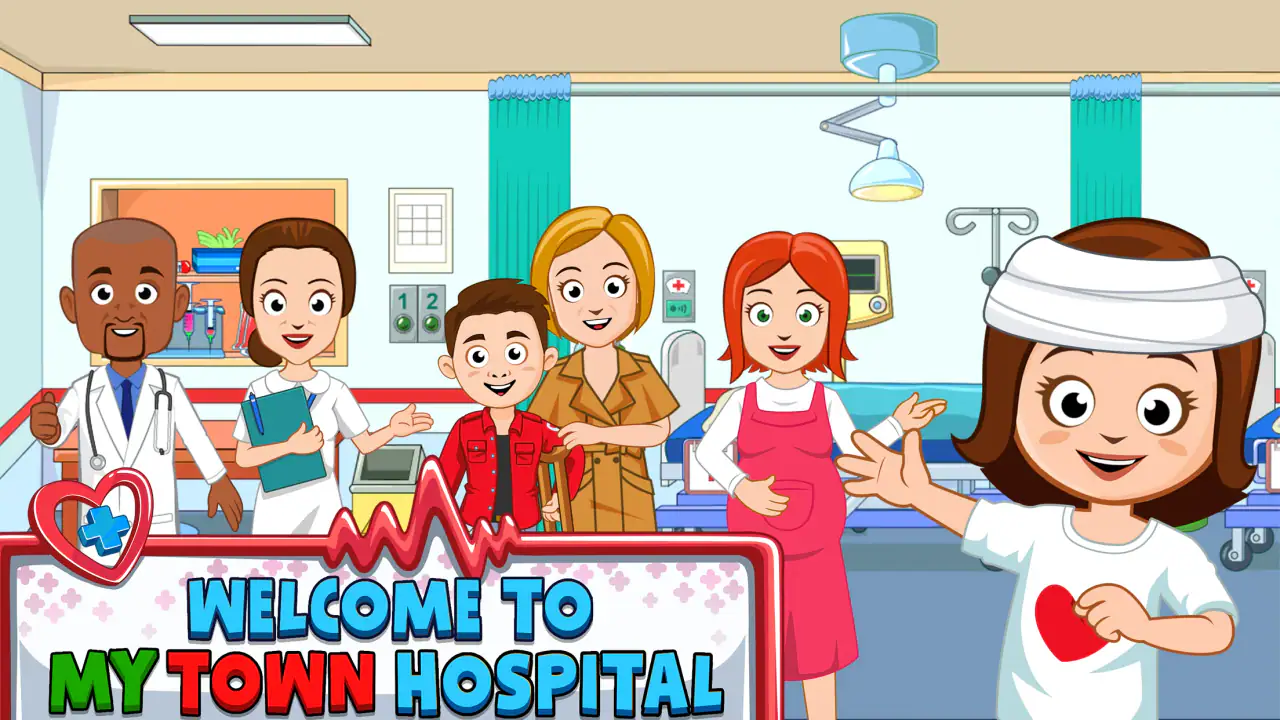
I would especially consider it for a quiet activity before dinner or during a short trip. In an everyday scenario, a child who has recently visited a doctor might use the game to replay the experience at their own pace. They can make the appointment feel funny, calm, dramatic, or completely different. That kind of replay may help them talk about what happened without being directly questioned about their feelings.
Parents should remember that the hospital theme can also bring up worries. A sensitive child may find medical scenes uncomfortable even when the presentation is designed for general audiences. I would sit nearby for the first session, watch the child’s reaction, and help steer the story toward friendly care rather than frightening events.
What makes the setting more useful than a generic role-play room
A generic pretend-play app can be wonderfully open, but it may not give a child enough prompts to start. Here, the hospital provides natural questions: Who is waiting? Who needs assistance? Why did this character come in? Which adult should accompany them? These questions can support vocabulary and sequencing in a way that feels like play instead of practice.
One non-obvious benefit is that the setting can support social rehearsal. A parent can use the characters to model waiting patiently, explaining a problem, comforting someone, or asking for help. The child does not have to perform those conversations personally at first; they can make the characters do it. That distance often makes difficult topics easier to approach.
Another useful habit is to let the child explain the scene after arranging it. Rather than asking whether the “right” thing happened, I would ask the child to describe what each character is doing. This turns the game into a storytelling exercise and reveals whether the child understands the roles they have chosen.
What the current release tells existing players
The current version is 7.03.09, so this is not an untouched early release. The game originally appeared on September 2, 2015, which means it has had a long life compared with many mobile children’s titles. I see that history as a sign that the core concept has remained useful, but it also means expectations should be realistic: a mature title does not automatically feel like a brand-new game.
For someone discovering it now, the important point is that the current build is the version to assess, not the experience a family may remember from years ago. Existing players should update with the normal expectation that maintenance can improve compatibility and preserve the play experience, while the central appeal remains the hospital sandbox itself. I would not buy it expecting a completely different genre after an update.
The game requires Android 8.0 or later. That is worth checking before purchase, particularly if a child uses an older hand-me-down phone or tablet. On a compatible device, the main practical question is less about technical ambition and more about whether the screen is comfortable for small hands and whether the child enjoys free-form interaction.
The store information lists an average rating of 4.2 from around 1.9 thousand ratings, with more than 100 thousand installs. I read those figures as evidence of a real audience, not as a guarantee that every child will connect with the format. Open-ended games divide families: some appreciate the freedom, while others want visible goals and progress.
How it compares with the usual alternatives
Compared with a puzzle-based educational game, this one offers less measurable progress. There are no obvious spelling drills, arithmetic rounds, or quiz results to show a child’s improvement. If your goal is direct academic practice, a focused learning app will usually be a better choice.
Compared with a video app, however, it is more interactive and more adaptable. A child is not simply watching someone else’s hospital story; they are deciding who participates and what happens. That creates more opportunities for conversation, although it also requires more initiative from the player.
Compared with a general dollhouse game, the medical setting gives parents more ways to introduce real-life routines. The trade-off is that the theme is narrower. A child who prefers shops, houses, or fantasy worlds may lose interest sooner, while a child curious about doctors and hospitals may find the focused setting easier to enter.
I also see a difference from structured simulation games. Those usually reward completing tasks in a particular order. This title is better when the child wants to invent the order. That makes it gentler and less demanding, but it can feel unfinished to players who expect a clear checklist.
Cost, age suitability, and the purchase decision
The listed price is $4.49, and the content rating is Everyone. There are also in-app purchases priced at $0.99 per item. I would explain the purchase model to a child before handing over the device, especially if the device is shared. The upfront cost may make sense for a family seeking a dedicated pretend-play experience, but it deserves comparison with free apps if the child is only mildly interested in hospitals.
The age rating is reassuring in broad terms, but it does not replace supervision. A child’s emotional response to a hospital theme varies widely. I would not use the rating alone to decide whether it suits a nervous child, and I would avoid presenting it as a medical authority. It is a play environment, not a source for diagnosing symptoms or explaining real treatment.
One practical tip is to play together once before deciding whether the game has enough variety for your household. Watch whether the child creates several different scenes or repeats one action and stops. That small test tells you more about value than the rating does, because the main benefit depends on sustained imaginative use rather than a single completed level.
Remaining gaps and everyday friction
The biggest limitation is the absence of a strong built-in learning path. Children can explore care, communication, and routines, but the game does not replace a reading lesson, a health class, or a conversation with a professional. Parents who want clear explanations of the human body or medical procedures should look elsewhere and use this only as a playful supplement.
Free-form play can also create a supervision burden. A younger child may need help understanding how to begin, while an older child may want more challenge than the environment provides. The same openness that supports creativity can therefore feel shallow after repeated sessions.
The hospital theme may narrow its replay value for some families. Once a child has explored the main kinds of stories they enjoy, they may ask for a broader world with more locations or stronger progression. I would see that as a reason to alternate it with other creative activities, not necessarily as a flaw in its intended design.
The purchase model is another point to monitor. Even when the main experience is appealing, optional item purchases can complicate a child’s understanding of what is included. I recommend keeping purchasing under adult control and treating any extra item as a deliberate decision rather than an automatic extension of play.
There is also a difference between emotional realism and playful representation. A child may use the game to rehearse a doctor visit, but the simplified world should not be treated as an exact guide to what will happen in a real hospital. I would use it to open a conversation, then answer real questions in age-appropriate language.
Small techniques that improve the experience
My favorite approach is to give the child a simple problem without dictating the solution. “A visitor is worried and does not know where to go” is enough to start a scene. The child then chooses the characters, invents the dialogue, and decides how the situation ends. This encourages planning and empathy while preserving the game’s playful nature.
A second technique is role rotation. If two children are playing, let them switch responsibilities halfway through the session. One may begin as the person needing help and later become the helper. This prevents one child from controlling the entire story and makes the hospital setting more collaborative.
A third is to use the game for preparation rather than correction. Before an actual appointment, a parent can invite the child to create a calm arrival scene and talk through what questions they might ask. The goal is not to promise that the real visit will look identical, but to give the child a safe way to express expectations.
For language development, pause the action and ask for a beginning-to-end explanation. Who arrived first? What did they need? Who helped? What happened afterward? This turns character movement into sequencing practice and is more valuable than simply tapping every object as quickly as possible.
What to watch as the product continues
Because the title has been available since 2015 and now carries version 7.03.09, I would watch future updates mainly for how well they preserve accessibility and smooth play on supported devices. Existing families should pay attention to whether the experience remains comfortable on their particular phone or tablet after updating, especially when a child relies on an older device.
I would also watch whether the game continues to feel worthwhile for children who have already explored its hospital stories. The key question is not whether it becomes more complicated, but whether it keeps supporting fresh role-play. For this kind of game, variety in possible conversations and scenarios matters more than adding difficulty for its own sake.
Parents considering a purchase should watch the child’s play style rather than chasing the average rating. A child who invents dialogue, enjoys caring roles, and likes making scenes will probably get more from it than a child who needs levels, rewards, or explicit instructions. That is the clearest dividing line I found.
My recommendation after spending time with it
I recommend My Town : Hospital to families looking for a gentle, imaginative hospital-themed activity that can support storytelling and conversation. Its educational category is appropriate when understood broadly: the learning happens through role-play, language, social situations, and familiar routines rather than through formal exercises.
I would skip it if you want a serious medical simulator, a structured curriculum, or a game that continually introduces harder challenges. I would also think twice if the child is uncomfortable with medical settings or quickly loses interest in open-ended play. In those cases, a puzzle-focused educational title or a broader creative game may be a better match.
For the right child, though, the lack of a fixed path is precisely the appeal. I can imagine returning to it when a child wants to replay a real-world experience, make up a caring story, or simply spend a quiet period moving characters through an imaginative setting. The best value comes when an adult occasionally joins in, asks thoughtful questions, and lets the child remain the director.
My final view is positive but specific: this is a focused pretend-play game, not an all-purpose learning solution. Its current version, long-running availability, Everyone rating, and established audience make it a reasonable option for compatible Android devices, while the $4.49 price and optional $0.99 items make it worth matching carefully to the child’s interests. If hospital role-play sounds naturally appealing, I think it can earn a place in a family’s creative app collection.
FAQs for My Town : Hospital
What is My Town: Hospital?
My Town: Hospital is a kid-friendly digital role-playing and storytelling game where players can explore a hospital and create their own scenarios. You can visit different departments, interact with doctors, nurses, patients, and family members, and use objects throughout the building. Instead of following one fixed storyline, the game encourages open-ended play and imaginative situations.
What can you do in My Town: Hospital?
The game lets you act out many hospital-related stories, such as checking in at reception, examining patients, visiting treatment rooms, caring for newborns, or helping characters recover. Players can move characters between rooms, change outfits, use medical equipment, and combine items to create different scenes. Its flexible design makes it suitable for repeated, creative play.
Is My Town: Hospital suitable for children?
My Town: Hospital is primarily designed for children who enjoy pretend play, exploration, and creating stories. The interface is colorful and generally easy to understand, with familiar tap-and-drag controls. Parents should still review the app’s age rating, privacy information, advertising settings, and any purchase options, because the exact experience may vary depending on the device and version installed.
Does My Town: Hospital require an internet connection?
Many of the game’s basic activities can usually be enjoyed offline after the application has been installed, which is convenient for travel or areas with limited connectivity. However, an internet connection may be needed for downloading the app, receiving updates, restoring purchases, or accessing certain external features. It is best to test offline access on your device before relying on it.
Is My Town: Hospital free to download and does it include purchases?
Availability, pricing, and included content can differ between the Android and iOS versions, as well as by region. Some editions may be paid upfront, while others may offer additional content through in-app purchases or related My Town applications. Before downloading, check the store listing carefully for the current price, purchase details, advertising information, and supported devices.
Pros
- Bright
- child-friendly graphics make the hospital easy to explore.
- Many rooms and medical tools encourage imaginative role-play.
- Characters can be moved freely between different hospital areas.
- Simple controls are suitable for younger children.
- Offline play is useful when traveling or away from Wi-Fi.
Cons
- Some areas and characters may require additional purchases.
- Open-ended play may feel repetitive after extended sessions.
- Limited objectives provide little challenge for older children.
- Frequent tapping can make interactions feel slower than expected.
- The game may use considerable storage and battery during play.


